
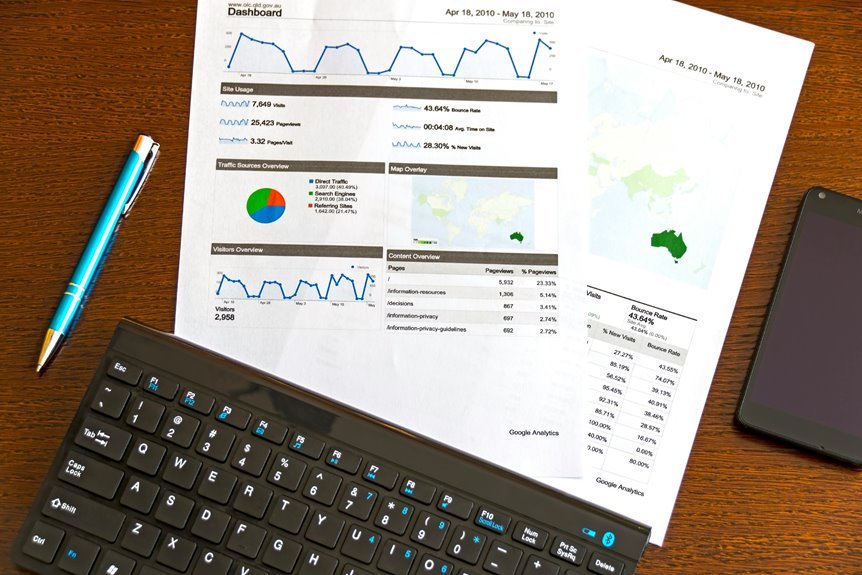
Financial Performance Dashboard: 8449861927, 8453023586, 8455203526, 8458362040, 8472578339, 8474911100

The financial performance dashboard serves as a pivotal instrument for organizations aiming to optimize their financial oversight. By integrating various key performance indicators, it provides a comprehensive overview of financial health. Metrics like net profit margin and return on investment facilitate precise analysis. However, the true value lies in how these visualized data points drive strategic decisions. An exploration of its impact on financial agility and market responsiveness reveals deeper implications for organizational success.
Understanding Key Performance Indicators (KPIs)
Understanding key performance indicators (KPIs) is crucial for organizations aiming to gauge their financial performance effectively.
KPI definitions provide a framework for measuring success, while KPI examples illustrate practical applications. Metrics such as net profit margin and return on investment enable businesses to assess efficiency and profitability.
Analyzing Financial Metrics for Strategic Decision-Making
Analyzing financial metrics plays a pivotal role in strategic decision-making, as organizations leverage data to navigate complex market environments.
By employing financial ratios, decision-makers can assess profitability, liquidity, and efficiency, enabling informed choices.
Furthermore, data visualization enhances comprehension of trends and patterns, facilitating a clearer understanding of financial health.
This analytical approach empowers organizations to adapt strategies, fostering resilience and growth.
Leveraging Dashboards for Enhanced Financial Management
How can organizations effectively utilize dashboards to streamline financial management?
By implementing dashboard customization, firms can tailor visualizations to their specific needs, enhancing clarity in data interpretation.
This adaptability supports more precise financial forecasting, enabling companies to anticipate market trends and adjust strategies accordingly.
Ultimately, such dashboards empower organizations to make informed decisions, fostering greater financial agility and independence.
Conclusion
In conclusion, the financial performance dashboard serves as a pivotal platform for precise performance monitoring and proactive planning. By harnessing key performance indicators (KPIs) and critical financial metrics, organizations can cultivate clarity and confidence in their decision-making processes. This data-driven dynamic ultimately drives agility, enabling enterprises to swiftly navigate shifts in the market landscape. Thus, a well-structured dashboard not only enhances efficiency but also empowers stakeholders to pursue strategic success with certainty and clarity.